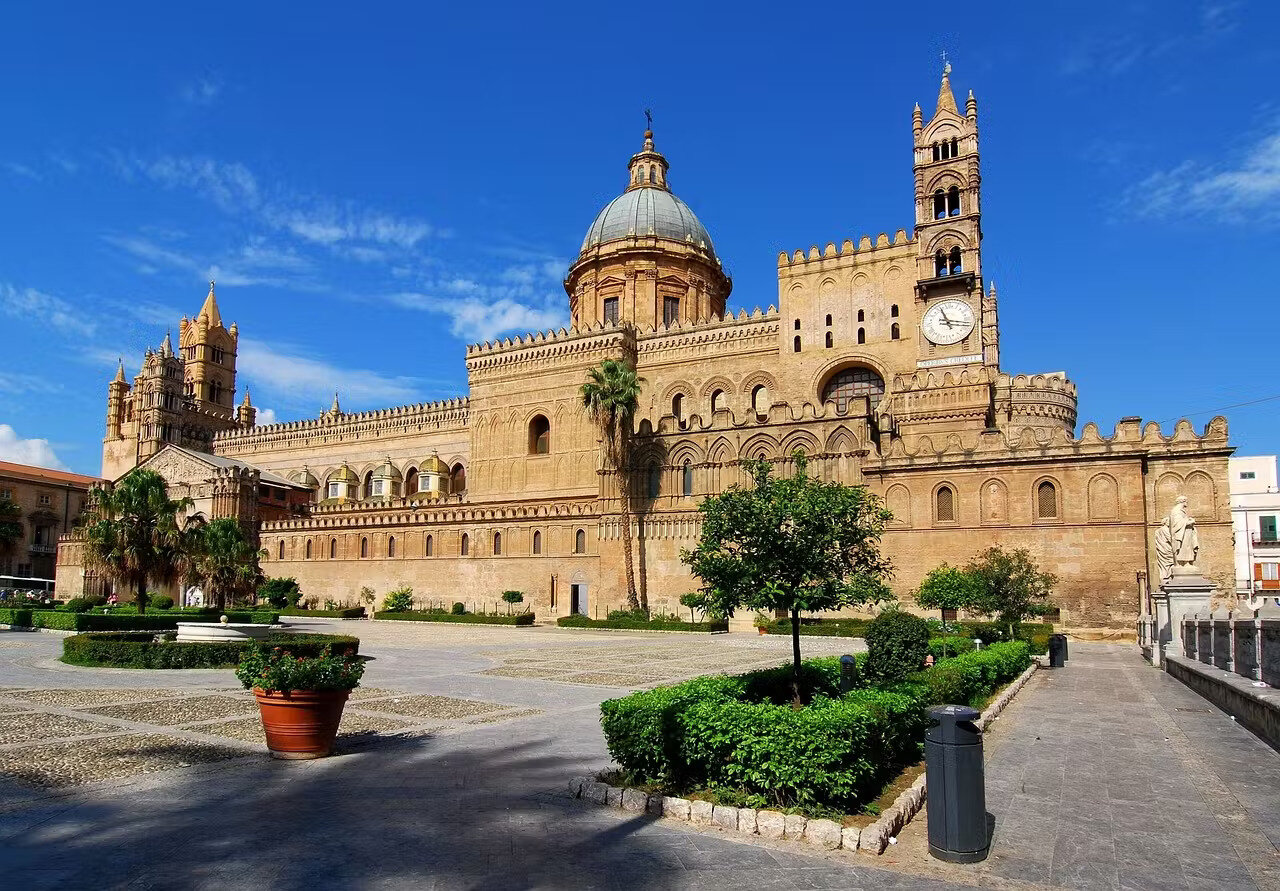
This is the most important Catholic place of worship in the city of Palermo. It can also simply be called the Palermo Cathedral, but its official name is the Metropolitan Primate Basilica Cathedral of the Holy Virgin Mary of the Assumption. Yes, said like that it sounds a bit intimidating, but after all, with its battlements and geometries, the apses covered in majolica, and arches of various styles, it is part of the serial site of Arab-Norman Palermo and a UNESCO World Heritage Site. That said, it goes without saying that it is one of the must-see places if you are in Palermo. A bit of history Tracing all the phases of the construction of this building is truly not easy: it starts from the walls of a Phoenician-Punic settlement, passes through a necropolis and Roman catacombs, the construction on the same site of a Byzantine temple which later became the base for a Saracen mosque, the Great Mosque Gami; up to the Norman era, when Roger I of Sicily and his brother Robert Guiscard conquered the island and reaffirmed Catholicism. From then on, the Palermo Cathedral, although initially not undergoing external modifications except for the minaret which was transformed into a bell tower, was consecrated to Christian worship. It was not yet 1100. In February 1164, an earthquake, interpreted by the people as a sign of the political and religious corruption of the time, damaged the monument. It was therefore decided to rebuild it, making the building as magnificent as was expected for the kingdom to become again. Gualtiero Offamilio, then Bishop of Palermo, oversaw the reconstruction and in 1185 presided over the solemn consecration of the new majestic Palermo Cathedral.
Since then, the cathedral has undergone numerous modifications, sometimes with great success (such as the three-arched portico from the 15th century by Antonio Gambara, which took 200 years to complete), and sometimes with less fortunate results (as in the case of the modifications made according to a project by Ferdinando Fuga between 1781 and 1801). According to some, fortunately Fuga's work did not extend to the external east facade, which is still adorned with the exotic designs of Gualtiero's cathedral, and to the southwest facade, which was built in the 13th and 14th centuries and is a fine example of local craftsmanship in Gothic style.
Today, the entrance to the cathedral, with its four Norman-era towers and the wooden portal made in 1426 by Miranda, is preceded by a statue of Saint Rosalia, one of Palermo's patron saints. Above the arches, a decoration depicting the tree of life in a complex geometric composition of Islamic style, composed of 12 medallions showing fruits, humans, and animals, probably dating to the late 1200s.
Entering the Palermo Cathedral, with its three naves, on the left is the Monumental Area, which houses several Norman royal tombs. The remains of two of the greatest Sicilian rulers are preserved here: Roger II and Frederick II of Hohenstaufen, as well as those of Henry VI and William II.
The cathedral's treasury also houses a small collection of jewelry and religious relics from the Norman era. The most extraordinary piece is the 13th-century crown of Constance of Aragon (wife of Frederick II), made by local craftsmen in very fine gold filigree and studded with gems.
Perhaps less precious, but more bizarre treasures include a tooth and the ashes of Saint Rosalia, kept in silver reliquaries.
The truth is that, just as it is difficult to trace the history of the Palermo Cathedral, it is also difficult to untangle the architectural elements that compose it, so many are the styles. Capitals, columns, statues, friezes and decorations; arches, columns, floors, paintings and mosaics, crypts... There are many ways to approach a visit to this eclectic masterpiece of Palermo architecture and art, two fundamental ones: let yourself be fascinated and get lost, or be guided by an expert. Our advice is to experience both, then take a relaxing walk through the streets and alleys of the center, among the stalls of a market with fragrant and colorful local products. Maybe taste some typical Sicilian dish, in a restaurant, or seize the opportunity from the many stalls offering Palermo's excellent street food.
La Residenza dell'Alloro
Via Alloro 107, Cap 90133 - Palermo - P. Iva: 12499890965
The Cathedral of Palermo
The Cathedral of Palermo
2025-01-18 16:30
2025-01-18 16:30
Array() no author 87835
the monuments of Palermo,