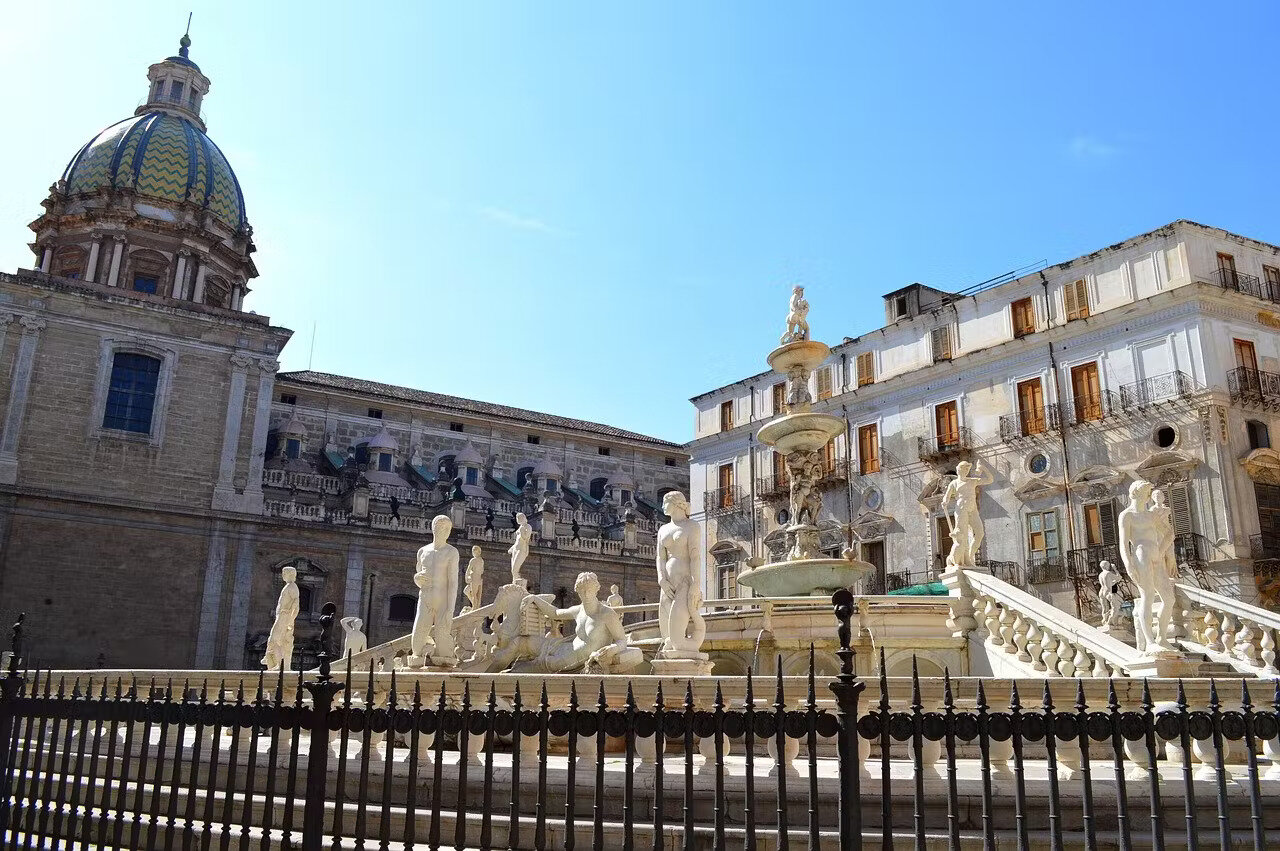
Fontana Pretoria or Fountain of Shame? The people of Palermo have nicknamed this imposing fountain located in Piazza Pretoria in Palermo. In reality, it was designed in 1554 by the Florentine architect and sculptor Francesco Camilliani and was initially placed in Florence, in the palace of Don Luigi Álvarez de Toledo y Osorio, brother of Grand Duchess Eleonora di Toledo and Marquis García Álvarez di Toledo. 27 years later it was sold to the Senate of Palermo, and this did not please the people of Palermo, who considered the expense excessive and shameful, despite the authoritative opinion of Giorgio Vasari, who called the fountain stupendous, without equal in Florence and perhaps even in Italy: "A most stupendous fountain that has no equal in Florence." A bit of history The reason why the fountain was acquired by the Senate is linked to family intrigues and the desire of the then Palermo praetor Giovanni Villaraut to financially help Luigi Álvarez, as he was the brother of his friend García Álvarez, who was once viceroy of Sicily. Camillo Camilliani, son of Francesco Camilliani who had created it, was entrusted with supervising the work: eccentric and not at all modest or restrained in expenses, together with his imaginative collaborator Michelangelo Naccherino, they worked on the fountain until 1581. The result was a "vastasa" work, with concentric basins arranged symmetrically on three levels, which in the eyes of the citizens represented the corruption of the city municipality, disliked not only for the squandering of public money but also for the immoral nudity of the statues. It is said that the unveiled statues especially bothered the nuns of a nearby convent, who were forced to pass by every day.
Originally, the fountain, elliptical in shape and made of Tuscan marble, was composed of 48 statues, as well as stairs, balustrades, pedestals, niches, and other decorative elements, which were sectioned and dismantled into 644 pieces, of which only 112 were packed into 69 crates and transported along the Arno with typical Tuscan sailing boats, then by sea with ships to the port of Palermo. The remaining pieces never reached Sicily, but found placement elsewhere, some in uncertain locations, between Florence, Naples, and Spain.
What, handsomely paid for, arrived in Palermo required the repair of some damaged parts, and the reassembly of the fountain involved the addition of pieces, the demolition of buildings to make space for it, with consequent compensation for the owners.
The original meaning of each part and statue of the fountain, when it became the Pretoria Fountain because it was placed in the square facing the Palazzo Pretorio, was partly modified. Thus, it was established that the statues in the four basins on the first level represented the Palermo rivers Gabriele, Oreto, Papireto, but not the fourth watercourse, which should have been the Kemonia, but rather the springs that give rise to the artificial lake of Maredolce. The other statues represent real and imaginary animals, tritons and nereids, mythological deities. In particular, you can recognize Venus and Apollo, Adonis and Diana, Hercules, Mercury, and Pomona. The statue of Bacchus, on the third level, was reinterpreted by the poet and adventurer Antonio Veneziano, a sixteenth-century author of many verses in the Sicilian language, as a representation of the Genius of Palermo, the city's tutelary deity, together with Saint Rosalia.
Over time, the Fountain of Shame suffered numerous acts of vandalism, which, in addition to further restoration costs, led to the installation of a security fence in 1737.
The lack of appreciation for the work continued even in the 1800s, after the fountain also became the object of disputes between Messina and Palermo residents, with defacements inflicted by the former on the fountain and by the latter on Montorsoli's Neptune, in retaliation. The fence, designed by the architect Giovan Battista Filippo Basile in 1858, was removed in 1865 after one of many restorations (note that the last restoration began in 1998 and ended in 2003), but was repositioned in 1872, and still today surrounds the fountain, which, despite much controversy, remains one of the most spectacular urban features of the city.
One further curiosity about the Pretoria Fountain in Palermo: the issuance of a 25-lira stamp by the Italian Post Office in 1973.
La Residenza dell'Alloro
Via Alloro 107, Cap 90133 - Palermo - P. Iva: 12499890965
Pretoria Fountain
Pretoria Fountain
2025-01-18 16:25
2025-01-18 16:25
Array() no author 87835
the monuments of Palermo,