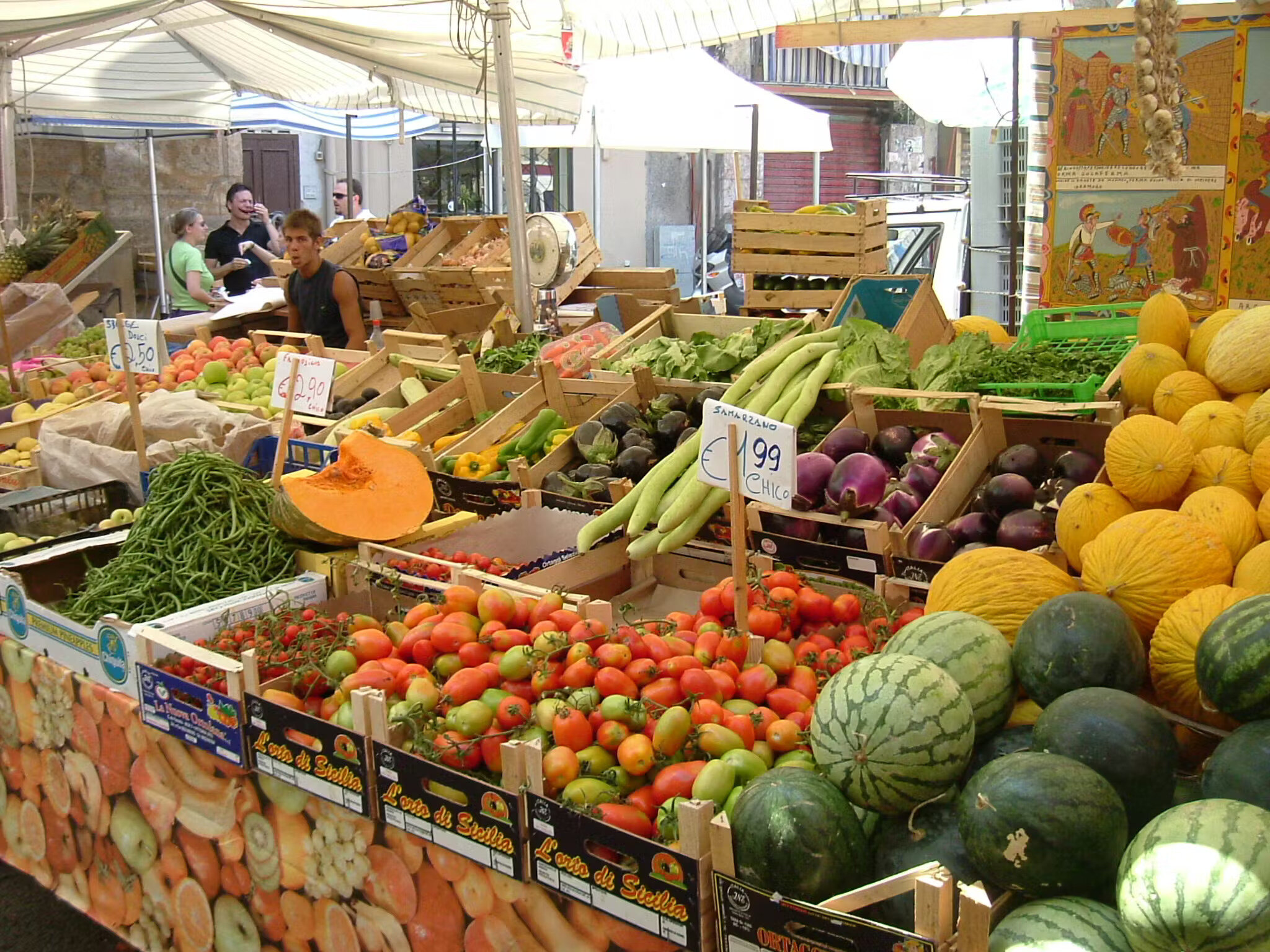
Accessible every day, from Monday to Sunday morning, Ballarò is without a doubt the most famous and oldest market in all of Palermo. With its thousand-plus years of history, the Ballarò market is in every respect a historical monument of the Sicilian capital. Along the streets and alleys of Albergheria, figures of national and international importance have passed, heads of state, celebrities, and streams of tourists enchanted by its extraordinary atmosphere and the variety of goods available. Here, in fact, you can buy everything, from seasonal fruit and vegetables to meat, fish, typical regional products, and plenty of street food. Among these stand out panelle, arancine, crocché, stigghiole, pane cà meusa, cannoli, cassate, and much more. Ballarò, like all the other historic markets of the Sicilian capital, is an authentic must-see on tourist itineraries: visiting this market projects you into a timeless dimension, where the shouts of the vendors, the scents, the colors, but above all, the extraordinary hospitality of the Sicilian people reign supreme. The oldest market in Palermo is located in the popular Albergheria district and is an absolute must-visit, as it is able to offer an unforgettable experience. Try it to believe it! The history of the Ballarò Market When you walk through the streets and alleys of some of Palermo's historic districts, you get the impression of having landed in an Arab souk. It is no coincidence that some of the oldest markets in the Sicilian capital were created precisely during the years of Arab rule. Even today, many of them have the look, smells, and colors of a typical North African bazaar. The custom of loudly calling out to passersby, of filling squares and streets with baskets, stalls, and colorful awnings, are some of the traditions to which Sicilians are most attached. And so, the Ballarò market represents the perfect place for a dive into the most authentic traditions and past of the people of Palermo. We are talking about a true living monument, which for centuries has vibrated with the energy, friendliness, and hospitality of generations of merchants. An essential stop on a tour of Palermo, these picturesque markets are the perfect synthesis of the cheerful and colorful nature and the cosmopolitan culture of the Sicilian people. As mentioned earlier, the origins of this market date back to the 10th century, when the Arabs took over the island. The very name of the market is said to derive from the Arabic word Balhara, which indicated a small village of merchants located near the Monreale district, where spices and typical North African products were sold. Originally, therefore, Ballarò was probably known as Suq Al-Balhara. However, this is not the only theory regarding the origin of the name Ballarò: another hypothesis refers to Ag-Vallaraja, an Indian locality known for the trade of spices from the nearby Deccan. Finally, a third, less credited hypothesis would derive the name Ballarò from the term Segeballarath, which can be translated as fair, market, or bazaar. What is certain is that anyone who decides to venture into the depths of this magnificent market is constantly accompanied by the calls of the street vendors who, just as happens in the streets of Marrakesh, Agadir, or Fez, invite you to buy vegetables, Sicilian citrus fruits, fish, and plenty of ready-to-eat food. These picturesque invitations are known by the dialect term "abbanniate" and help make millions of visitors fall in love with Palermo every year. Where is the Ballarò Market located As mentioned earlier, Ballarò is the largest and oldest market in the city: it stretches between Piazza Casa Professa and Porta Sant'Agata and includes dozens of stalls well known to the people of Palermo, who cannot help but stop and taste their favorite dishes. Until a few years ago, the Ballarò market was smaller than it is today, being gathered around the square of the same name. As Gaspare Palermo writes in the "Guida istruttiva per Palermo e i suoi dintorni" published in 1858, Ballarò was a lively and noisy square, located in the heart of the Albergheria district, elongated and quite narrow in shape, with a paved floor made of large stone slabs. Gaspare Palermo defines Ballarò as a “piazza di grascia,” a name that refers to the sector in which the various shopkeepers specialized. They mainly sold foodstuffs (grascia). Already at the beginning of the 19th century, therefore, the Ballarò square hosted a large market, intended for the trade of products coming from the countryside surrounding the city. Just as happens today, farmers and breeders gathered in this place with the aim of selling their goods to the hundreds of passersby and curious onlookers. Imported Arab products were by no means rare, helping to foster an ancient bond, reaffirming the Muslim origins of this splendid market.
La Residenza dell'Alloro
Via Alloro 107, Cap 90133 - Palermo - P. Iva: 12499890965
The Ballarò Market
The Ballarò Market
2025-01-18 16:22
2025-01-18 16:22
Array() no author 87835
The markets of Palermo,