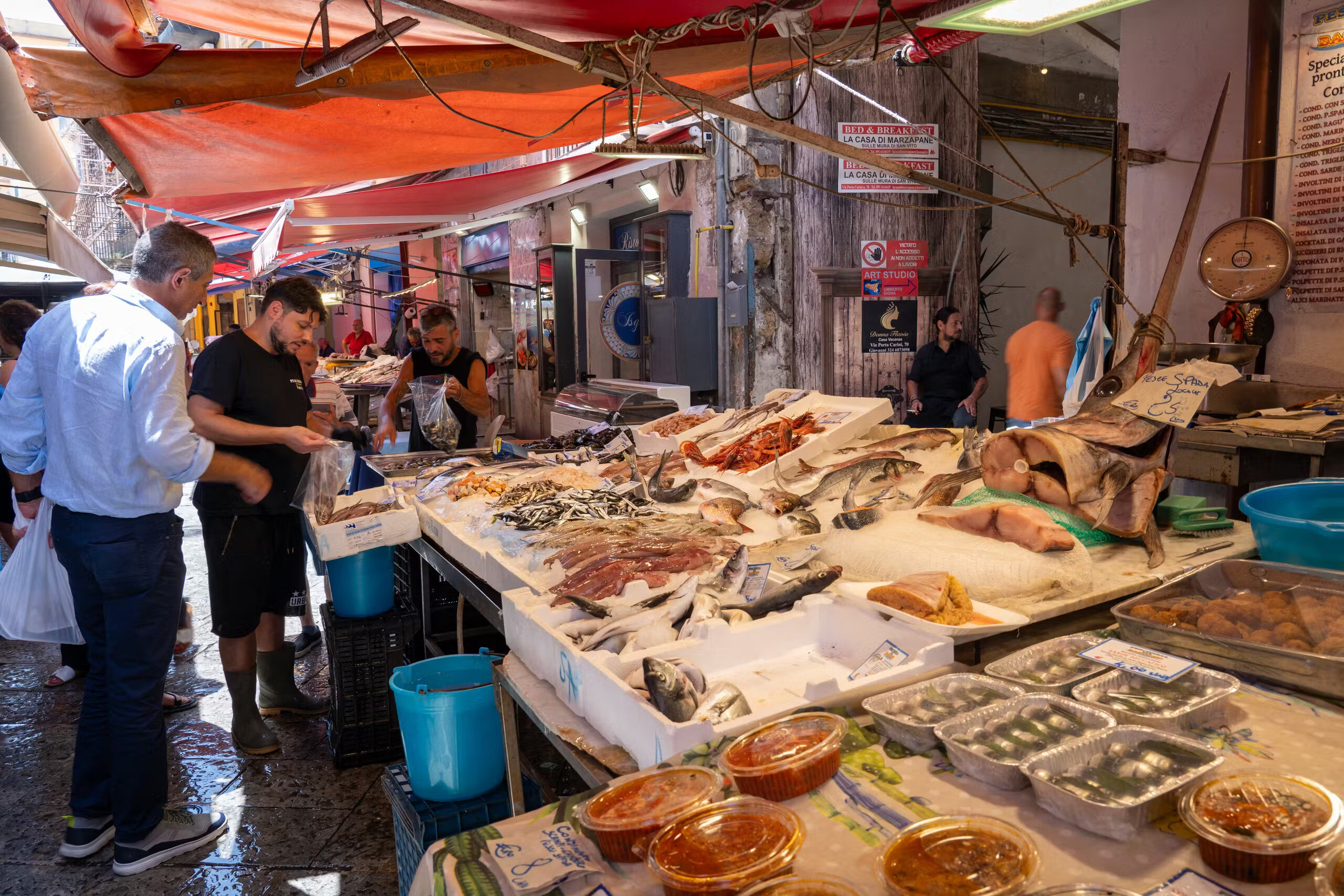
The Capo Market, named after the Capo district, takes place daily in the morning, even on Sundays. Like all typical markets in Palermo, it is a triumph of voices, colors, and scents; among typical products sold on the stalls, irresistible street food, and gathering places crowded with regular patrons of all ages who converse with the frankness and liveliness typical of the people of Palermo, helping to create the noisy chatter also typical of Ballarò, obviously of La Vucciria, Lattarini, and the Flea Market. A bit of history The origin of the name, of the district and the market, comes from that of the area: "Caput Sarecaldii", which later became simply "Capo", because it was located in the highest part of the ancient Seralcadio district, once in Muslim Palermo and which, after the expulsion of the Arabs and the reconstruction of the city walls, was populated by artisans and merchants. Now, from Porta Carini you descend towards Piazza Beati Paoli along a very colorful street of fruit, vegetables, and greens, very fresh fish, shellfish and mollusks, spices, and many other typical Sicilian products; sweet and savory delicacies, as well as characters who still represent the original spirit of the market, made up of observing, tasting, bargaining, and, of course, buying.
The history of the Capo market is often misunderstood and the information about it confused. It seems that, at the end of the 10th century, a merchant from Baghdad, Ibn Hawqal, already mentioned it in a travel diary. At the time of the Arab domination, it was still a series of stalls, outside the existing walls, above what was then the course of the Papireto river.
The structure of the Capo market as we know it, however, is linked to the Norman era and the new walls, within which it was included. It was then, starting from the 14th century, that the upper part of the sari-al-qadì district (street of the Kadì), a name that became Seralcadio, was distinguished and enhanced, and later completely reclaimed from the swamps resulting from the covering of the Papireto.
Under the tents of the Market, there is no shortage of street vendors selling lottery tickets, kids on scooters, and hordes of foreign tourists with astonished and bewildered faces, so that the "agri-food shopping center" looks more like a phantasmagoric circus without wild beasts and tamers.
And foreign vendors are welcome among the Capo stalls, who, in an increasingly multicultural and cosmopolitan context, help keep alive a Market that, between imported bananas and wild asparagus, remains a historic institution, with an identity so strong that it cannot be questioned.
Among the most mentioned in the reviews of those who visit the Capo market are the juices and smoothies made from fresh fruit: citrus fruits, of course, but also prickly pears and pomegranates; and the old-fashioned "grattatelle", the Palermo version of "grattachecca", made with shaved ice, fresh fruit, and syrup.
A gem of Sicilian and Italian cultural and food and wine heritage, the Capo market is definitely a stop to include in your itinerary to get to know Palermo and to grab some culinary souvenirs: whether it is street food to eat on the spot, arancine, crocchè, caponate, sfincioni, and panelle to take as a memory, or some bargain purchase to put in your suitcase. In this paradise for gourmets, the precious saffron stands out, the incredible variety of olives that Sicilians have learned to appreciate since the time of the ancient Greeks, pistachios, capers.
During your walk through the Market, it is worth stopping to admire the ancient buildings that have witnessed love stories, battles, invasions over time, the old gates, the many churches that have towered for centuries over the bustling crowd. Among them all stands out the 14th-century Church of Sant’Agostino, also known as "Santa Rita".
A peculiarity of the Capo market are the "abbanniate", the typical shouts of the vendors, common in all markets but which at the Capo market traditionally use particular metaphorical images. Listen to them carefully: you will discover that they associate white grapes with the blond curls of women's hair, the freshness of tuna (tunnina) with that of a young lady who can be kissed (often followed by a kiss to the tuna!), while zucchini and cucumbers lend themselves to spicy and colorful allusions.
La Residenza dell'Alloro
Via Alloro 107, Cap 90133 - Palermo - P. Iva: 12499890965
The Capo Market
The Capo Market
2025-01-18 16:15
2025-01-18 16:15
Array() no author 87835
The markets of Palermo,